There's something unsettling about Christmas when you really think about it.
We drag trees into our living rooms. We hang lights on houses that spend the rest of the year looking perfectly ordinary. We wrap things in colorful paper and place them beneath those trees, trusting that whatever is inside belongs there.
We gather around tables with people we love, people we tolerate, and occasionally people we'd prefer to avoid until next December.
And for a few days, we collectively agree that everything is wonderful.
Even when it isn't.
Especially when it isn't.
I've always found that fascinating.
Not the decorations or the presents or the music that begins playing approximately eleven minutes after Halloween ends.
The expectation.
Christmas comes with an enormous amount of it. We're supposed to be happy. We're supposed to forgive. We're supposed to remember the good things and politely ignore everything else.
But memories don't operate on a holiday schedule.
Neither does guilt.
And neither do the things we've buried.
Welcome to Bellwether
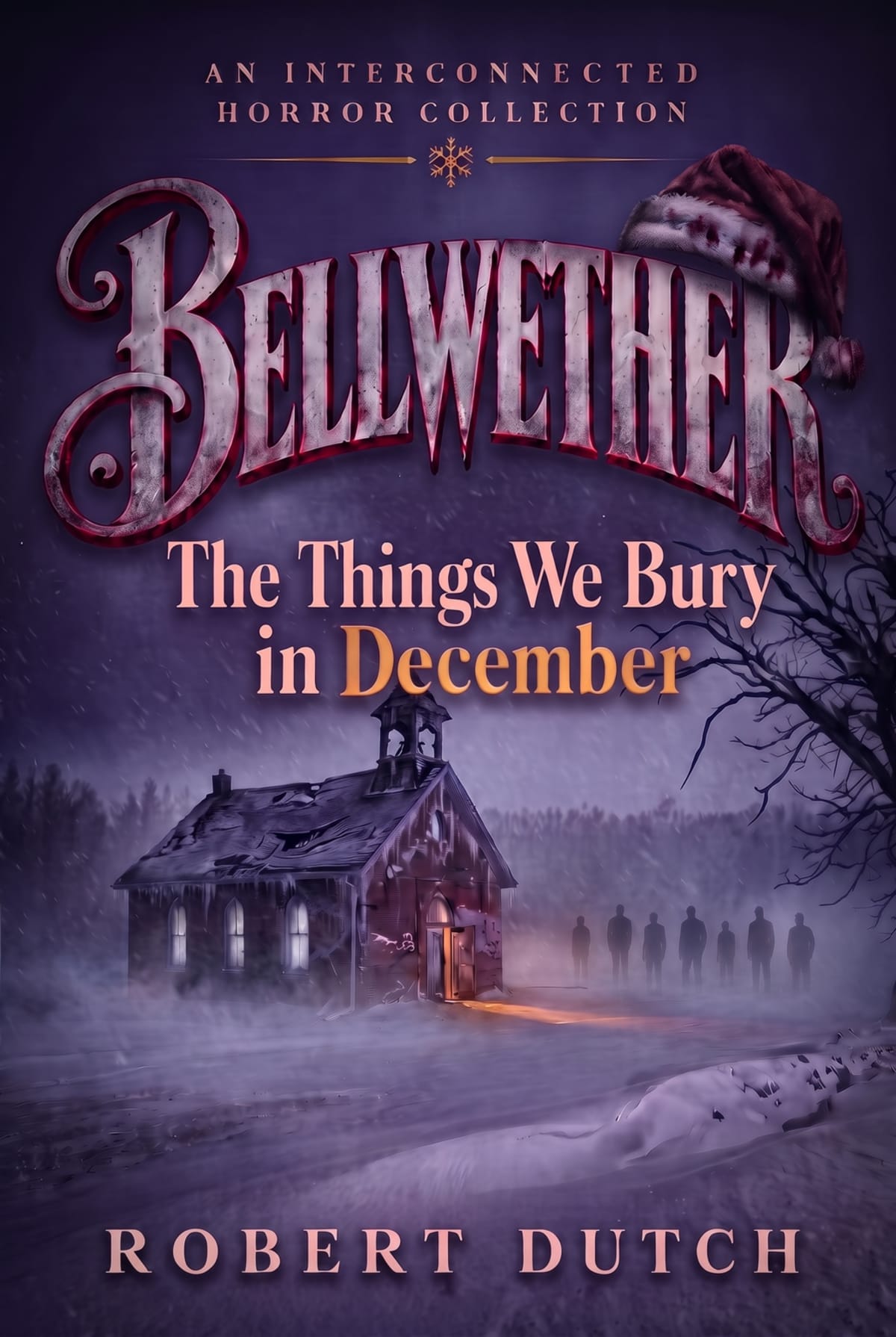
My newest collection, Bellwether: The Things We Bury in December, takes place in a town that understands the importance of keeping up appearances.
Bellwether has its traditions, its familiar faces, its Christmas decorations, and its secrets.
The stories are interconnected, each revealing another piece of a history that the town has spent decades trying to forget.
At the center of that history is Christmas Eve, 1986.
Seven people disappeared.
What happened afterward became something the town learned to live with. Or, more accurately, something it learned not to discuss.
That's the thing about secrets in small towns. They don't necessarily disappear because nobody talks about them.
Sometimes they become traditions.
Sometimes they become rules.
And sometimes the people who know the truth grow old enough that everyone else mistakes their silence for innocence.
Why Christmas?
Because Christmas makes an excellent accomplice.
Think about how much we're willing to overlook during the holidays.
An argument at dinner becomes something we promise to discuss in January. An empty chair becomes something nobody mentions. A family tradition continues long after anyone remembers why it began.
We decorate around the uncomfortable things. We cover them with lights. We put a ribbon on the box and tell ourselves we'll deal with whatever's inside another day.
And sometimes another day never comes.
That's the kind of horror that interests me.
Not simply the thing lurking outside the window, although I certainly have room in my heart for a good monster.
I'm interested in the person who sees something outside that window, recognizes it, and closes the curtains.
The person who knows.
The person who decides that knowing is somebody else's problem.
The person who has spent forty years convincing themselves that silence and innocence are the same thing.
They aren't.
And the longer a lie survives, the more expensive the truth becomes.
A marriage, a family, a reputation, even an entire town can be built around something nobody wants to acknowledge. Eventually, telling the truth threatens more than the people who originally buried it.
That's where I find some of the most interesting horror. Not simply in the revelation, but in its consequences.
What happens when someone finally tells the truth? Who suffers? Who benefits? And how many people would rather let something terrible continue than admit what they've already allowed?
Those questions don't require a monster.
Although, again, I'm not opposed to providing one.
Some Bells Aren't Meant to Be Rung
I won't tell you everything waiting in Bellwether.
That would rather defeat the purpose of inviting you there.
But I will tell you this.
The collection isn't simply about what happened on Christmas Eve in 1986. It's about what happened afterward.
The decisions people made. The stories they told themselves. The things they passed down without ever explaining them.
And the terrible possibility that some things remain buried only because everyone agrees to keep digging somewhere else.
If you've read The Room Isn't Empty Anymore: Book One, you'll recognize some familiar territory in the way I approach these stories.
I'm interested in what happens when ordinary people encounter circumstances they cannot control, and what those circumstances reveal about who they already were.
Sometimes the result is frightening. Sometimes it's heartbreaking. And occasionally, because I can't help myself, something is going to make you laugh at a moment when you probably shouldn't.
Your Invitation
Bellwether: The Things We Bury in December is available exclusively through PayMeToRead.com from November 7 through December 6, 2026.
Beginning December 7, the exclusive period ends, and the book is planned for wider availability.
If you're looking for a little darkness to accompany the holiday lights, I'd be delighted to have you visit.
And if you're new to my writing, you can also find The Room Isn't Empty Anymore: Book One on Amazon.
[EXPLORE THE ROOM ISN'T EMPTY ANYMORE: BOOK ONE]
Just remember that Bellwether is a small town.
People notice strangers.
They remember faces.
And they have a remarkable talent for knowing when someone has started asking the wrong questions.
Merry Christmas.
Try not to ring anything.
Robert Dutch
Ink in the Dark
Some bells aren't meant to be rung. 🔔